Tomahawk Steak
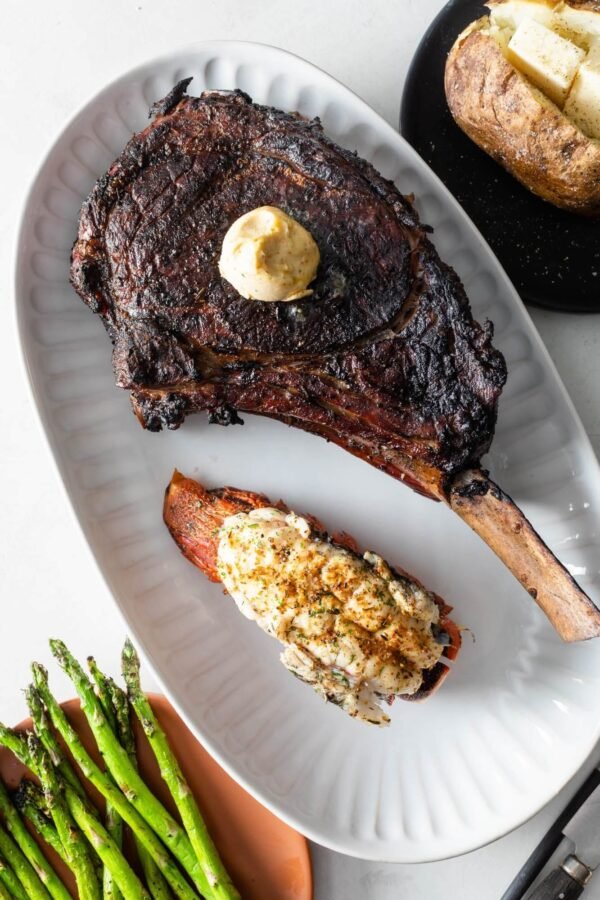
There’s a certain presence to a tomahawk steak.
When you pull it from the fridge, that long exposed bone and the cold, heavy ribeye attached to it tell you immediately: this is not a casual steak. It requires a bit of room, a bit of patience, and a method that respects how thick it is.
The good news? Cooking a tomahawk isn’t complicated—just deliberate.
The reverse-sear method is what makes cooking a thick steak feel controlled instead of stressful. Letting the meat slowly come up to temperature in the oven gives you a perfectly even interior. Moving it to a hot grill afterward gives you the deep crust and smoky edges you want from a tomahawk.
If you’ve never handled a bone-in ribeye this size, don’t overthink it. A thermometer tells you everything you need to know, and the grill does the rest. Slice it on a board, family-style, and let the juices run. It feels a bit dramatic, but that’s part of the fun of cooking a tomahawk on the grill—big cut, simple process, big payoff.
Throughout this recipe, you’ll naturally see examples of cooking a thick steak evenly, reverse searing a tomahawk steak, and finishing beef over high heat on the grill.
Do I really need the reverse-sear method?
For a tomahawk, yes.
It’s the most reliable way to cook such a thick steak evenly. Going straight to high heat risks burning the outside while the center stays cold.
Reverse sear makes temperature control almost foolproof.
Can I cook the whole steak on the grill only?
You can, but you’ll need a two-zone setup and constant monitoring.
Grill-only cooking often gives you a darker outside before the middle reaches temp.
If you want steady, even cooking, the oven + grill combo works better.
How do I know when to remove the steak from the oven?
Use internal temperature, not timing.
Thickness varies too much for “minutes per pound” rules.
Pull it at 110–125°F, depending on your preferred doneness.
Can I season the steak the night before?
Yes—dry brining helps the seasoning penetrate and dries the surface.
Just keep it uncovered in the fridge overnight.
Why rest the steak?
Resting allows internal juices to redistribute.
Cutting too early leads to a flood of liquid on the board and a drier steak.
Ingredients
Method
- Pat the tomahawk dry. Coat lightly with oil. Season all sides with salt and pepper—don’t forget the edges.
- Let it sit at room temperature for 30–40 minutes so the surface dries slightly. This helps build a better crust during grilling.
- Preheat oven to 250°F / 120°C.
- Place the steak on a wire rack set over a baking sheet.
- Insert a meat thermometer into the thickest part (avoiding the bone).
- Bake until it reaches:
- 110°F (43°C) for rare
- 118°F (48°C) for medium-rare
- 125°F (52°C) for medium
- This usually takes 45–60 minutes, depending on thickness.
- This step keeps the internal temperature even—no overcooked ring, no guessing. Many cooks think cooking such a thick steak on the grill only is harder; this method removes the stress.
- Set your grill to high heat—you want it properly hot before the steak touches the grates.
- Gas grill or charcoal both work.
- Charcoal adds smoke; gas gives cleaner control. Either is fine.
- Place the tomahawk on the grill and sear all sides:
- 1–2 minutes per side
- Turn until you get a deep, even crust
- Don’t forget the “fat edge”—hold it vertically with tongs to crisp it
- This step is quick because the steak is already at temperature.
- You’re building crust, not cooking it through.
- Transfer the steak to a cutting board. Rest 10 minutes—this keeps the juices from running out.
- Slice off the bone first, then slice across the grain into thick strips.
- You’ll see a gentle gradient from edge crust to a warm, rosy center—the look you expect when cooking a tomahawk steak properly.
Notes
More Recipes




There are no reviews yet. Be the first one to write one.